

Pioneering Oversight just launched a YouTube Channel! Here is the first upload narrating this post.
Every so often, particularly when Supreme Court decisions touch on deeply partisan issues in popular political conversations, politicians start talking about “court packing.” Both parties have their own take on this, but most lean on the “switch in time that saved nine” story we all heard in school—where FDR implemented a lot of New Deal programs, the old, stodgy Supreme Court stood in his way and struck them down. Then, under threat of being packed with new, loyal FDR justices, they changed their mind and started finding all these programs constitutional.
There is a bit more to the story than this, and I want to expand on FDR’s uncharacteristic political loss. The version we heard in school not only leaves out key facts, but undersells the moral of the story: court packing to remedy political losses is the wrong answer. The Supreme Court needs reform, and I think adding justices combined with term limits is the right answer, but we need to do so in a different way than simply “packing” and for very different reasons.
A President almost beyond reproach
In 1936, FDR’s New Deal policies were popular and largely successful. While the United States was not completely out of the Great Depression, things were certainly looking up. FDR’s political power was at a high point; the Democrats were united, and the GOP was in shambles, split within itself and grossly unpopular.1 When he accepted his nomination at the Democratic National Convention, he gave his famous “Rendezvous with Destiny” speech.
Governments can err, Presidents do make mistakes, but the immortal Dante tells us that divine justice weighs the sins of the cold-blooded and the sins of the warm-hearted in different scales.
Better the occasional faults of a Government that lives in a spirit of charity than the consistent omissions of a Government frozen in the ice of its own indifference.
There is a mysterious cycle in human events. To some generations much is given. Of other generations much is expected. This generation of Americans has a rendezvous with destiny.
FDR cruised to victory and continued to introduce New Deal legislation.
A court in transition
The Supreme Court in the 1930’s was a bit of a mixed ideological bag, slowly emerging from the Lochner era where the Court upheld laissez-faire economics and racial segregation. While they were old—Justice Brandeis, the oldest, was 80, five were in their 70s, and Justice Owen Roberts, the youngest, was 61—they were not the stodgy old conservatives they are often made out to be. That story might be a product of FDR’s frustration of being the only president since James Monroe to serve 4 years without making a single appointment to the court.
Four justices were certainly of the Lochner-era mindset and therefore could be characterized (though not always) as “anti-New Deal” (Justices Butler, McReynolds, Sutherland, and Van Devanter). Three were “liberals” and frequently (though not always) sided with New Deal legislation (Justices Brandeis, Cardozo, and Stone). The remaining two, Chief Justice Hughes and Justice Roberts, were “swing votes.” Justice Roberts notoriously switched sides on multiple issues.
During FDR’s first term, the Court ruled that 6 pieces of New Deal legislation were unconstitutional. Four were either unanimous decisions or nearly unanimous, and only two had a 5-4 split. Yet it also upheld major pieces of both federal and state New Deal legislation, including the Tennessee Valley Authority, price freezes, and broad powers of foreign affairs.
The Court also began a decades-long march in the defense of civil liberties.
“It reversed 100 years of precedent to hold the First Amendment’s guarantee of a free press applicable to the states. It overturned rape convictions of 9 young Black men in Scottsboro, Alabama. It made the Sixth Amendment’s right to counsel applicable to the states in capital cases. When the young men were tried again and convicted by an all-white jury, a unanimous court overturned that conviction as well.” It also unanimously defended the rights of communists to organize.2
The difference between what the court upheld and what it disposed of was largely due to the quality of drafting. Lots of New Deal legislation was often hastily drafted and quickly pushed through Congress. The Chief Justice said in the midst of the court packing scheme:
“I’m not interested in who are to be the members of the court. I am interested in the court as an institution. And this proposed bill would destroy the court as an institution.
If we had an Attorney General in whom the President had confidence, and in whom the court had confidence, and in whom the people had confidence, the story might have been different.
But the laws have been poorly drafted, the briefs have been badly drawn, and the arguments have been poorly presented. We’ve had not to be only the Court, but we’d had to do the work that should have been done by the Attorney General.”
The Scheme
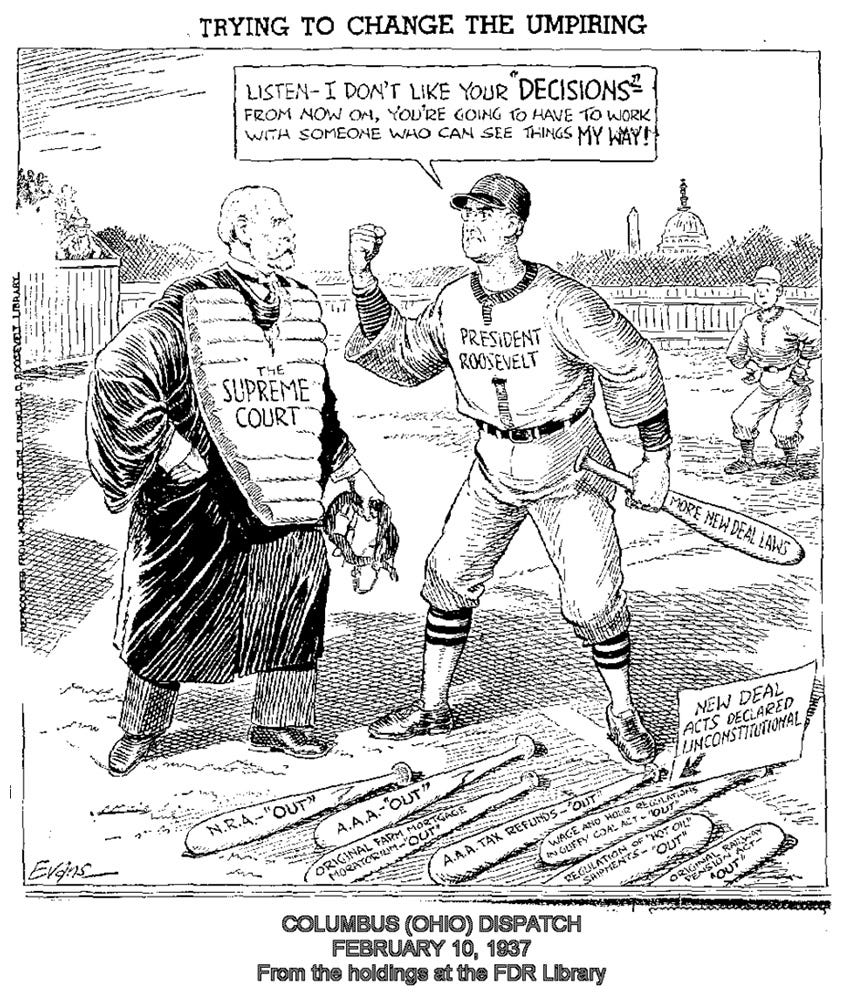
Despite the victories, FDR still looked at the Court as something standing in his way, and instead of attacking the Court on the merits of their decision, or taking responsibility for the hastily drafted legislation, he attacked the Court in a backhanded way by saying they were too old and couldn’t keep up with their workload. This was empirically false, but it was his story, and he stuck with it.
“The court plan is not liberal. A liberal cause was never won by stacking a deck of cards, by stuffing a ballot box, or by packing a court.” – Senator Wheeler (First Senator to Endorse FDR in 1932 and the leading opposition against the Court Packing Proposal).
When the court-packing legislation was introduced in Congress in 1937 via a letter from FDR, the reaction was far from favorable. Liberals and strong FDR backers were astonished and shocked that they had not been consulted. In the Senate, Vice President Garner held his nose and turned his thumb upside down as the message was read. The Supreme Court was likewise shocked and betrayed, and the justices from across the spectrum, including liberal Justice Brandeis, opposed the move. There were some folks, coincidentally, the next Supreme Court Justice pick, Hugo Black, who was at the time an Alabama senator, rallied around the bill. But overall, people were anywhere from uncomfortable with it to flat-out opposed to it. This bill was never going to pass.
A switch, but not one in time
So the Court packing scheme was already a dead letter, despite FDR’s immense political capital. What happens next, the so-called “switch in time,” is where the Supreme Court failed magnificently in a matter of optics. The Court heard a case, West Coast Hotel Company v. Parrish, in 1936. This was a case dealing with a Washington State minimum wage law. The Court, in December of 1936, months before anyone knew of the Court Packing scheme, voted to uphold the law 4-4.
Justice Roberts, the conservative swing vote, voted for the bill. Roberts definitely flip-flopped on this issue. He voted in favor of striking down a very similar New York law six months earlier. Yet he voted to uphold a similar legal principle in the 1934 case Nebbia v. New York. Why did Justice Roberts change his vote three times in two years? It is unclear. The only thing we know for certain is that he did not change it because he thought the Court was threatened by FDR.
Unfortunately for the Court, and all our understandings of what happened, Justice Stone was sick that December, so the Chief Justice delayed the vote, and the subsequent reading of the decision, until the Spring of 1937, giving the impression that the Supreme Court was changing its tune at the behest of the President. Interestingly, going back to how NOT anti-New Deal the Court was, on the same day, they read 3 more unanimous opinions all upholding New Deal legislation.
To pile on the evidence against our popular understanding of this story, FDR continued to fight to pack the Court, despite everyone wanting him to stop. It was as if FDR couldn’t accept defeat, even in a practical victory. Ironically, about a year or so later, FDR got his first Supreme Court pick, one of nine he would ultimately appoint. The Court’s independence survived, and over the next 60 years it brought in justices from all over the country and from a wide range of political ideology and judicial philosophy, but over the last 20-25 years, that geographic and intellectual diversity has eroded.
Reform
The Supreme Court needs reforming. It is too highly concentrated with D.C. insiders, basically a Harvard and Yale alumni club, and there is something frustrating about getting stuck with a justice for 30+ years with no recourse. Before I lay out my case for 13 justices, I want to make one thing clear: Supreme Court reform is not going to fix the country’s inherent structural political problems. Steve Vladeck points out many different ways Congress can check the Supreme Court. There have been multiple opportunities to pass legislation to protect rights or overturn decisions, and our representatives failed in that respect. No amount of court packing will replace enshrining protections in legislation or the Constitution.
That aside, I want to make the case that 13 justices, combined with term limits3 or a mandatory retirement age, is the right amount. We need to have one justice from each circuit—the only true way to make the Court more responsive to different segments of the population.
An east coast club
Despite ideological differences, there is not much geographic diversity among the Supreme Court justices. Four justices came from the DC Circuit, and one (Kagan) was not a judge before being appointed, but the Solicitor General of the United States, a highly DC-centric job. Two more justices have experience rooted on the East Coast, with service on the Second and Third Circuits. Barrett and Gorsuch are the only ones who break this model, having served on the 7th and 10th Circuits, respectively.
Additionally, the Court and the entire federal judiciary are largely fed by Harvard, Yale, and a handful of other private schools. Here are some stats I found when I wrote about this a year ago:

8 of 9 Supreme Court justices went to Harvard or Yale.
30% of all federal judicial appointees came from Harvard, Yale, or Columbia.
70% of federal judges got their J.D. from a private school.
The last time a justice attended a public law school was Justice Hugo Black, who attended the Alabama School of Law. He was appointed in 1937 and died in 1971.
Each circuit has its own case law and idiosyncratic dockets. For example, the 9th and 5th Circuits have massive immigration caseloads, while the 2nd Circuit has more financial matters on its docket because New York and Connecticut are within its jurisdiction. The 10th Circuit, containing Oklahoma and the “mountain west,” has a larger share of American Indian Law.4 Caseloads and specialty laws aside, I think it is safe to say that a justice who has spent time on a circuit or in any state west of the Hudson or Potomac for that matter, may have, at least in theory, a more nuanced understanding of the issues facing those states.
Here is a snapshot of what I mean:
The Court just made a pivotal decision on the Voting Rights Act; only 2 justices were even born in the south, and none served in a circuit where this decision will have outsized impact.
Likewise, the Court made some big decisions this term on immigration; none served in the 9th or 5th Circuit, where all the southern border states (except AZ) are, and thus much of the thorny immigration law is made and heard.
On a more positive note, Justice Gorsuch’s experience in American Indian Law is precisely because he served on the 10th Circuit, a historically neglected area of law, and the expertise he brings to the Court.
How do we ensure the Supreme Court is more attuned to the laws, customs, and issues facing different regions of our country?
Require 13 seats on the Supreme Court, one per circuit. Then, require that a Supreme Court justice serve in the circuit—either on the federal bench or on a state’s supreme court—for 5 years before being eligible for appointment to that circuit's Supreme Court seat.
I can’t say for certain how much requiring a Supreme Court justice to come from the circuit they represent will increase the court’s scholastic diversity, but it will begin to force more diverse legal experiences onto the Court than we already have.
Adding these justices to the Supreme Court doesn’t have to turn into court packing. You can add them slowly, one or two at a time, spread out over a handful of midterm and presidential elections. If you combined this reform with 18-year term limits, you would end up with a staggered system, much like the Senate, allowing for a smoother system that is both consistently responsive to the electorate, attuned to the unique legal issues that face different areas of our country, and somewhat insulated from day-to-day politicking.
None of this is to say political power isn’t key in driving the country in the right direction, or that the Supreme Court is really “above politics.” The goal, however, can’t be to bludgeon a branch of government into submission. Turning the court into a rubber stamp for a political party is the wrong move. If we want to continue to govern ourselves, we need to figure out how to strengthen the systems of checks and balances while not sacrificing responsiveness and representativeness. There is a way to have both, and if we look beyond FDR’s court-packing to the rest of his time in office, we can see the answer: structural reforms, a responsive Congress, and political will.
Sources
I leaned heavily on two sources. One, Scorpions by Noah Feldman, a fantastic book on the personalities of Roberts, Frankfurter, Black, and Douglas. And FDR by Jene Edward Smith, a totem of a book, but a superb biography of FDR.
Huey Long, FDR’s most formidable opponent within the Democratic Party, was assassinated in 1935.
FDR by Jean Edward Smith.
I’m open to counter-arguments about term limits. I suppose there is a game-theory aspect to this: an outgoing justice may be more inclined to vote in a manner contrary to judicial canons and principles because there are no consequences for having to deal with their mess later. However, there is also plenty of evidence that having justices serve an average of 28 years has any real benefit either. https://www.brennancenter.org/our-work/analysis-opinion/life-tenure-us-supreme-court-justices-global-oddity-clear-costs
It’s hard to find data actually spelling this out. Much of what I found is anecdotal or gleaned from sources that address this indirectly.