

There are only a few more “opinion” days left in this current Supreme Court session, and as Steve Vladeck points out, there are 23 19 remaining opinions yet to be issued.1 I was lucky enough to attend the oral arguments2 for West Virginia v. B. P. J., one of two cases around the extent to which states can prohibit transgender girls from playing on sports teams of their gender identity. West Virginia v. B. P. J. centered on whether the state laws would violate Title IX, and the other case, Little v. Hecox (actually first on the docket), centered on whether the state laws would violate equal protection and the 14th Amendment.
I’ve gone back and forth about whether to publish this piece before or after the decision comes out, but I think the best answer is to publish it before. When decisions are rife with civil rights implications for both parties involved, especially ones that lend themselves to divisive political rhetoric, there are going to be upset people no matter what. But because of this, and because I saw these arguments in person, I can detach myself from the policy outcome and the legal reasoning of whatever awaits us in the final decision. Instead, I want to highlight what I found to be a reinvigorating and underreported democratic atmosphere surrounding the whole process, something I wish more people had the opportunity to experience. I found myself contemplating four distinct worlds of American politics and lamenting the hyper-focus on the loudest, least-meaningful voices at the expense of everyone else.
The Serene & Articulate
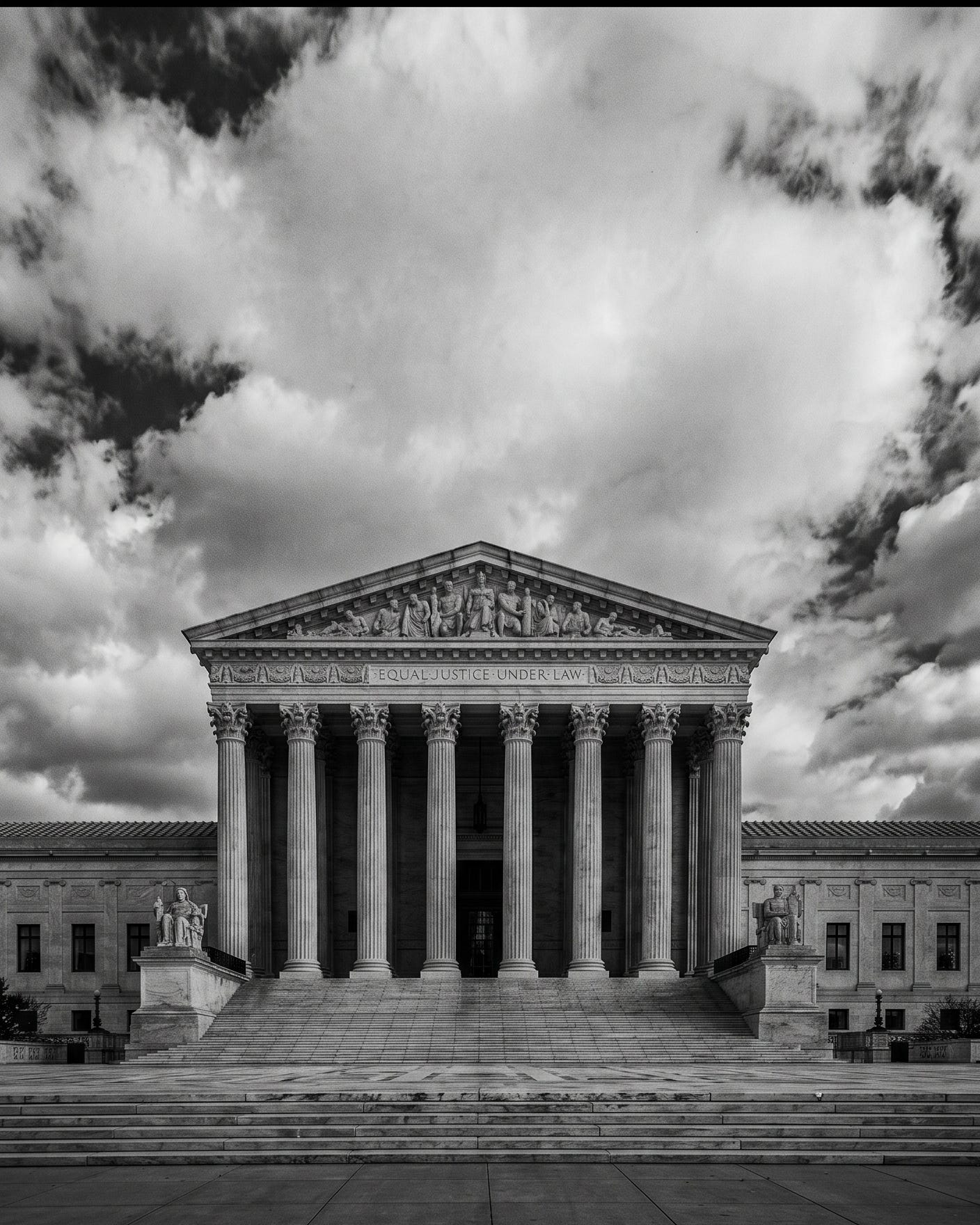
I got to the courthouse about 7 a.m. and stood in the line on the south side, unaware that there was a special line on the other side for ticket holders. I only had tickets for the second case and was hoping I’d be able to get into the first one. I didn’t get into the building until about 10, as the first case was wrapping up, but the next three hours turned out to be an equally important part of my day.
I was in line, with a few other people who ended up forming an impromptu debate group. One was a woman in her mid-70s who played women’s basketball for an elite school when women’s sports were a radical concept. Another was a trans woman, former D-I hockey player who transitioned later in life. Two young university students majoring in journalism were there also.
As we warmed up, the conversation got going. There were pretty stark differences of opinion. The trans woman framed her opinion in terms of her personhood, supporting the notion that, should a trans woman use the appropriate testosterone blockers, they should be allowed to compete on the team in the gender they identify with. The basketball player disagreed, seeing a lifelong fight for equal space in the sports world being encroached upon by biological men who will forever have an unfair advantage. The university students asked some tough questions, putting their own experiences out there. Their trans friends, they said, were actually surprisingly split on the issue. Everyone seemed to know what the normal testosterone levels for males were and the genetic markers responsible for their use were, except me.
It was the most civil discourse on a divisive subject I have heard in a long time. It was animated and passionate, but not angry, ad hominem, or nasty.
The Appointed & Deliberate
Inside, I was admittedly a bit giddy. The whole process was highly controlled, from tickets to entry to a briefing by a police officer letting us know they have a strict no-protest policy. When we were finally let in, it felt like walking into an inner sanctum. Arguments were already happening. The 9 justices sat in large leather-backed chairs in a somewhat elongated semicircle. Counsel was directly in front of them, and their plus-ones (I assume) sat behind them. Clerks and the Supreme Court Bar sat on the sides, facing inward, and reporters were somewhere in the mix, though I was unsure where. I was in with the general population directly facing the justices sitting in what were basically church pews, that could have fit maybe around 250 people, though it wasn’t that full.
I had a thought, briefly, that it was unfair how few people could see this, and maybe we should be live-streaming the arguments or doing this in a stadium, so all of America can see what is happening.3 However, I think it is probably better we don’t, as it would dramatically alter the nature of the proceedings. The judges asked some really hard questions, and it is harder to turn something into a performance if there isn’t a chance it can be used as a political sound-bite later.
All the judges looked and sounded professional, and all asked hard questions of both sides. No one let bad answers slip. Thomas and Alito were the most physically active, leaning back and forth in their chairs, and Jackson was mostly furiously writing. Roberts barely spoke. I’m not sure Alito would have said anything had it not been for a lawyer pretty blatantly making a statutory-interpretation faux pas.4
Gorsuch, Barrett, Kagan, and occasionally Sotomayor would build off each other’s questions, ping-ponging back and forth. Kavanaugh, despite being fairly nondescript in his approach, brought the only “real people” perspective into questioning: sports teams are a zero-sum game, what happens when a trans woman bumps a nontrans woman off her spot on the roster?
I gleaned no sign of the unfriendliness that is supposedly eating away at the court from within. No one made faces when the other justices spoke, although occasionally they did at the lawyers who were arguing. At one point Thomas very conspicuously slid his gigantic chair closer to Sotomayor to whisper and, I think, laugh with her about something.
I very much felt that every judge took the arguments seriously and understood the gravity of the case. They all seemed very concerned about the limiting factors, in their opinion, and about how the words they would draft would mean for future efforts to ensure gender equality.

The Loud & Glib
The part I left out, between the civil discourse when I was standing in line, and the judicial interrogation, was the “protests.” I had to wind my way through this pretty small group to get into the building. Funny enough, it was the only part that was shown to the world. I got tons of messages asking about my trip, and nearly every one asked how divisive the oral arguments were or about the protests. “It seemed really intense,” one friend wrote. It wasn’t.
The “protest” was small, maybe a couple hundred people altogether, tops. There were nearly as many cops as there were protestors. There were equal numbers on each side (a very misrepresentative picture of how Americans think about the issue).5 It was loud and uncivil, yet a 15-second clip of it made it to the television set. Should one of those TV cameras have walked a few hundred feet around the building, they would have gotten a much different, more nuanced, and more informed take on what was happening. I’m convinced that Americans would be just as interested, if not more interested, in watching 15 seconds of the street debate I listened to that morning than a couple dozen hooligans with posters yelling at each other.
Everyone Else
The last group of people I saw was the other 99% of America going about their daily business. They were zipping around Washington D.C., serving coffee, mowing lawns, dropping kids off at day care. I guarantee you if you stopped any one of these people and asked their opinion on the issues being heard, they would have one. I bet you that while they may not be able to follow Title IX spending-clause analysis, they would probably be able to understand the different levels of scrutiny and the effects of hormones on sports performance—I mean, everyone I was in line with did.
The American electorate is continually underestimated. Politicians and the media are constantly in search of “the everyman” –an imprint of an imprint that will be an avatar for whatever it is they think is most important to them (and should be for everyone else). But the fact is that there is no American “everyman.” The “everyman” was actually the four women with divergent opinions debating outside of the Supreme Court, in complete control of the issues, the law, and their tempers.
Four were released between writing and publishing.
It actually is not that hard to go see a case, provided you can make it to D.C. The ticket system is a lottery, so literally anyone has a chance (a pretty good one too, I won on my first submission) to see oral arguments.
Oral argument audio is live, but no video is.
At one point, a lawyer suggested that states be able to define sex under Title IX, and, from my perspective at least, seemed to immediately regret it.
The loudest are barely representative of 10% of Americans.